Websites & Online Shops
Custom websites and online shops, built around your business
Website design and development in Harrogate, North Yorkshire. Designed for the business behind it, built in-house, and handed over so you can run it.

Website design and development in Harrogate, North Yorkshire. Designed for the business behind it, built in-house, and handed over so you can run it.
20+ years
building custom websites, since 2006
80% by referral
of our new work comes through referrals
8 to 12 weeks
for most website projects
Wonder Media designs and builds custom websites for businesses in Harrogate, across Yorkshire and throughout the UK, and has done since 2006.
Brochure sites, content-managed sites your team updates often, online shops, and sites that sit on top of something more complicated - a booking system, a property feed, a member area. If a site needs logic behind it rather than pages in front of it, that is web development, and it is the same team either way.
The build is chosen to fit the job, not the other way round. WordPress with a custom theme where the site is content-led and the team updates it often. Headless, with Astro on Cloudflare's edge network and a CMS behind it, where speed is the priority and the content model is stable. WooCommerce or Shopify for shops, depending on what you sell and how you sell it. Each of those has a reason, and we will tell you which one we would pick and why before you commit to anything.
What does not change is the standard underneath. Every page is designed for your business rather than adapted from a theme bought for the purpose, the code is written rather than generated and shipped unread, and you talk it through directly with the developer building it.
This is the standard scope. Anything beyond it is priced separately and set out in the proposal, so you can see what you are paying for.
No lock-in
You get a perpetual licence to everything we build for you. If you ever want to take the site to another developer, you can, and we will hand over what they need to pick it up.
Some of our longest client relationships started with a straightforward first website and grew from there, a piece at a time. The pattern repeats often enough to be worth describing.
A clean, fast site that works properly from day one, easy enough for you to update, and built so it can be added to later rather than replaced.
New functionality as your business changes: booking, e-commerce, gated content, enquiry handling. Added to what is already there instead of starting again.
CRMs, payment systems, third-party feeds. When off-the-shelf tools have stopped fitting, we build what does. There is no discovery phase to pay for, because we know the codebase.
Maintenance and development time each month, and hosting if you want it with us. The same team that built your site, who know how it works and what your business needs, on hand when you need them.
A business with twelve staff and a clear brief does not need stage three in its first year. It needs a site that works, performs in search and does not need a developer to change a phone number. That is what we build, and we will say so if that is all you need.
E-commerce web design is its own discipline, and most of the cost sits in the parts customers never see: how products are structured, how stock is handled, what happens at checkout when something goes wrong, and what your team has to do every time an order comes in.
WooCommerce suits shops that are part of a larger content-led site, or that need the checkout, pricing or product types bending to fit something unusual. Shopify suits shops where the selling is the whole business and you want the platform to carry the payment and fraud burden. We build on both, and we have built checkout flows and payment integrations from scratch where neither platform did the job - Stripe, GoCardless and PayPal among them.
Not every shop is a shop, either. We have built a voucher system that sells local-business gift vouchers across a network of sites: basket, Stripe checkout, voucher codes issued so that two customers can never be sold the same one, refunds and voids, and payout reporting for the businesses redeeming them. That is custom e-commerce rather than a store with a theme on it, and it is the kind of thing the platforms are not built for.
Shops vary too much for a price range to mean anything, so they are scoped individually after a conversation about volume, product complexity and what the shop has to talk to.
People searching for a website builder are usually trying to work out whether they need an agency at all.
| What we build | |||
|---|---|---|---|
| Comparison | Site builder (Wix, Squarespace, AI builders) | WordPress, custom built | Custom build on the edge (Astro + Cloudflare) |
| Suits | A few pages about your business | Content-led sites, updated often | Speed, or sitting on top of other systems |
| Design | Their template, shared with thousands | A theme coded for you | Every page coded for you |
| Speed | Generated code you cannot fix | Fast when built properly | Served from near the visitor, no server in the path |
| Editing | Their editor, within its limits | Full CMS, admin stripped back | CMS of your choice, or a simple editor |
| Being found | Bloated markup, structure you do not control | Yours to optimise | Yours to optimise, fast by default |
| Connecting to other systems | Their app store | Plugins, or custom code where they do not fit | Anything with an API |
| Where it runs out | The first thing they did not anticipate | Plugin sprawl, if nobody maintains it | Structural changes need a developer |
If a builder covers what you need, use one. We would rather say that than sell you a project you will not get the value out of. For a business whose customers already know the name and just need an address, an opening time and a way to get in touch, a builder is a perfectly good shop front.
It gets harder when you need to be found by people who have never heard of you. The markup is generated for you rather than by you, you do not control the structure search engines read, and the page weight is whatever the platform decides it is. That is fine if search is not where your customers come from, and a problem if it is.
And it stops being the answer entirely when the site has to do a job - pull live data from somewhere else, hold customer information securely, take bookings against live availability - or when you need someone accountable at the other end of an email when it breaks.
Google uses Core Web Vitals as a ranking signal, and visitors leave slow sites before they have read anything. Neither of those is fixed by installing a caching plugin at the end of a project, which is why page weight, image handling and script loading are decisions made while the site is being built.
Lean HTML, correctly sized images in modern formats, deferred non-critical scripts, and Cloudflare in front of everything. Sites built on the edge platform go further, because pages are pre-rendered and served from a data centre close to the visitor with no server in the path at all.
Every page is tested through GTmetrix before handover. We target Grade A scores across the board as a standard, and 98 is our average across the sites we build.
Want to see what technical optimisation looks like across an ongoing campaign? See our SEO service.
301 redirect map
Rebuilding a site that already ranks is the point where most of the damage is done. URLs change, redirects get missed, and traffic that took years to build disappears in a fortnight. We map every existing URL to its new home, put 301 redirects in place before launch, and keep the content that is earning its place rather than throwing it out because it does not suit the new design.
Content comes across as part of the project, including sites with hundreds of pages, without your team rekeying anything. Old platforms are familiar ground - Joomla, classic ASP, legacy content systems nobody supports any more, WordPress installs patched by four different people over a decade. Where the original platform has run out of road we have rewritten classic ASP applications into PHP and modern frameworks rather than patching them further.
We wrote up what happens when this is done badly, using anonymised traffic data from a site that came to us afterwards: what happens when you rebuild without an SEO migration.
Most website projects take 8 to 12 weeks from the start of the project. We work on a small number of projects at a time, so the start date depends on the next available slot, and we confirm that before anything is committed. The thing that most often moves a finish date is content - copy, photography, product information - so where any of that needs writing or sourcing, we build it into the schedule rather than wait on it.
A half-hour call, free and no obligation - long enough to work out what you need and whether we are the right fit. What your business does, what the site has to achieve, what is working now and what is not.
In writing: what is included, what is not, and a fixed price worked out from the hours the job needs rather than a number picked to look right. That is the figure you pay.
Structure and page list first, then design, starting with the homepage to set the look and feel, then the other key page types. Designs are revised until you are happy with them, and nothing gets built until you have approved how it looks.
Everything is built in-house. Once there is a working version on a staging site you review it and we refine it, then content goes in, and before launch it is tested on physical phones, tablets and desktops as well as simulators, across the current browsers.
Redirects, SSL and DNS are handled at our end. The launch date is yours to set, and clients often time it around a campaign or a rebrand. Afterwards you can host and maintain the site with us, or take it elsewhere.
8 to 12 weeks
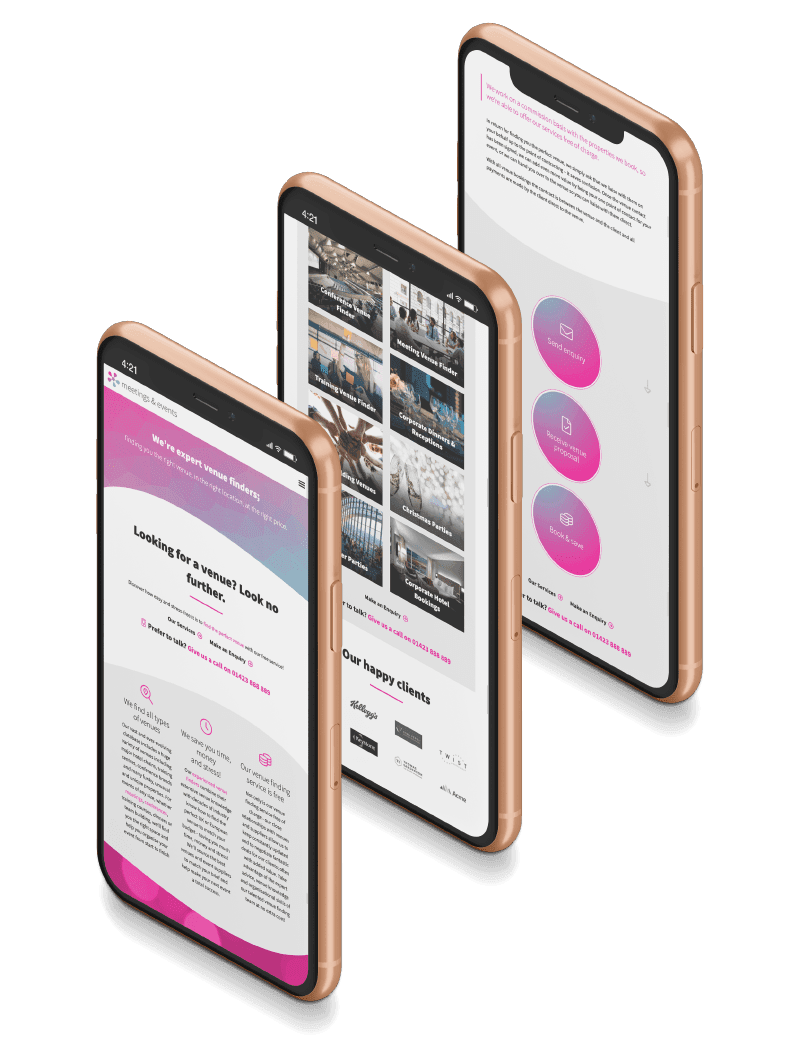
What started as a rebrand and one website has become four projects across two brands for the Harrogate venue finders: two full builds each, a custom enquiry system, individual venue pages with their own URL structure, and ongoing SEO. Read the case study.

A warm, accessible WordPress site for a charity supporting police families through the financial pressure of raising children in life-changing circumstances. Accessibility was the brief rather than an afterthought, and we worked through every iteration with them until it was right. Read the case study.
Most website projects fall between £5,000 and £10,000, and the difference is almost always the number of page templates that need designing, how much of the content needs writing or restructuring, and whether anything has to talk to another system. A fifteen-page site reusing four templates sits near the bottom of that range. A site with specialist landing pages, a migration from an old platform and an integration or two sits near the top. Online shops and custom systems vary too much for a range, so those are scoped individually. Whichever it is, the price is worked out from the hours the job needs and quoted as a fixed figure before you commit.
It comes down to who is editing the site and what it has to do. WordPress with a custom theme is the right answer for most content-led sites: your team gets a familiar editor, the admin is stripped back to the fields you use, and there is a plugin ecosystem for the things that are solved problems. A headless build with Astro on Cloudflare's edge network is the right answer when speed is the priority or the site is feeding off other systems, because pages are pre-rendered and served from a data centre near the visitor. We make the recommendation at scoping and explain the trade-off, including the ongoing cost of each, so the decision is yours with the information in front of you.
Text, images, pages, products, news, team members - anything that is content, you can change. The CMS is configured around your content rather than left in its default state, so you get structured fields instead of a blank page editor, which means updates cannot pull the design apart. Layout and structural changes are where you would come back to us, and that is what a maintenance plan covers. We take your team through it at handover.
Rankings follow URLs, so the first thing we do on a rebuild is map every existing URL and decide whether it survives, changes address or goes. Anything that moves gets a 301 redirect in place before launch, and pages that are earning search traffic keep their content even if the design around them changes. It is the single most common thing to get wrong in a rebuild, and the reason sites lose traffic they had spent years building.
Yes, on WooCommerce or Shopify depending on the business. WooCommerce where the shop is part of a bigger content-led site, or where the checkout, pricing or product types need to work in a way the platform does not do out of the box. Shopify where selling is the whole business and you want the platform carrying payments and fraud. We have also built checkout flows and payment integrations from scratch, including Stripe, GoCardless and PayPal, where neither platform fitted. Shops are scoped individually rather than priced from a range.
Because "a website" covers everything from a template with your logo dropped in to a custom build with systems behind it, and because agencies are priced very differently from one another. At the low end you are usually buying a theme, configured. That is a legitimate service and for some businesses it is the right one, but you are paying for setup rather than design and development. At the high end you are often paying for the agency as much as the work: account managers, strategists, a creative director, an office, and a portfolio with household names on it that lets them charge accordingly. The site you get is not necessarily better than the one a smaller team would build. We sit in the middle deliberately - the range of work you would expect from a larger agency, done by the experienced developer you speak to directly, with nobody in between for the brief to get lost in.
No. We host most of the sites we build and we would recommend it, because we built your site and we're also looking after the server it runs on, and you are not stuck between two suppliers when something goes wrong. You are not tied to us though. You get a perpetual licence to everything we build for you, and if you would rather host elsewhere, or move later, the site goes with you. Our hosting plans are published with prices if you want to compare.
Tell us what the site needs to do and we'll tell you what's involved, what it costs and how long it takes. You'll be speaking to the developer who would design and build it.