
This is based on a real project involving a real business. We've anonymised the details because the point isn't to name and shame - it's to show what actually happens to organic traffic when a website rebuild goes ahead without SEO migration planning.
We had access to the Google Search Console data before, during and after the rebuild. The numbers speak for themselves.
The setup
The business in question was a well-established company in a competitive service sector. They'd been operating for over 20 years and had built up significant organic search authority over that time. Their website consistently ranked on page one for dozens of high-value commercial keywords in their industry.
We'd worked with this client for over 15 years. During that time, we'd managed multiple website revisions, always preserving their search rankings through careful redirect mapping, URL structure retention, and staged rollouts. Their organic performance was strong and stable.
In early 2025, the client decided to commission a full website rebuild. We were initially involved and had planned the project with SEO continuity as a core requirement - including redirect mapping for every indexed URL, preserving high-ranking page structures, and maintaining the URL hierarchy that Google had been crawling and ranking for years.
What went wrong
Partway through the planning phase, the project direction changed. An external consultant was brought in to lead the creative direction, and the previously agreed technical framework - including the SEO migration plan - was set aside in favour of a visual-first approach.
The key issues were structural, not cosmetic:
No redirect mapping.
Hundreds of indexed URLs were changed or removed without 301 redirects pointing to equivalent content. Google followed the old URLs, hit 404 errors, and dropped them from the index.
URL structure replaced entirely.
The existing hierarchy that Google understood and ranked was thrown out. New URLs with no search history replaced pages that had been accumulating authority for years.
High-ranking pages deleted.
Several pages that ranked on page one for competitive terms were removed entirely - not redirected, not replaced with equivalent content. Just gone.
No staged rollout.
The new site went live all at once, with no phased migration and no monitoring period. Every URL changed simultaneously.
No signed scope or change control.
When the project direction shifted, no formal change control process was followed. SEO risk warnings were noted but not escalated into governance decisions.
We'd flagged the SEO risks early in the process. Preserve the high-ranking pages, map every redirect, don't change the URL structure without a plan. When the project direction changed and those warnings were effectively set aside, we made the professional decision to step away rather than be associated with a build we believed would cause significant organic damage.
The data
The rebuild went live in mid-2025. The impact on organic search performance was immediate and severe.
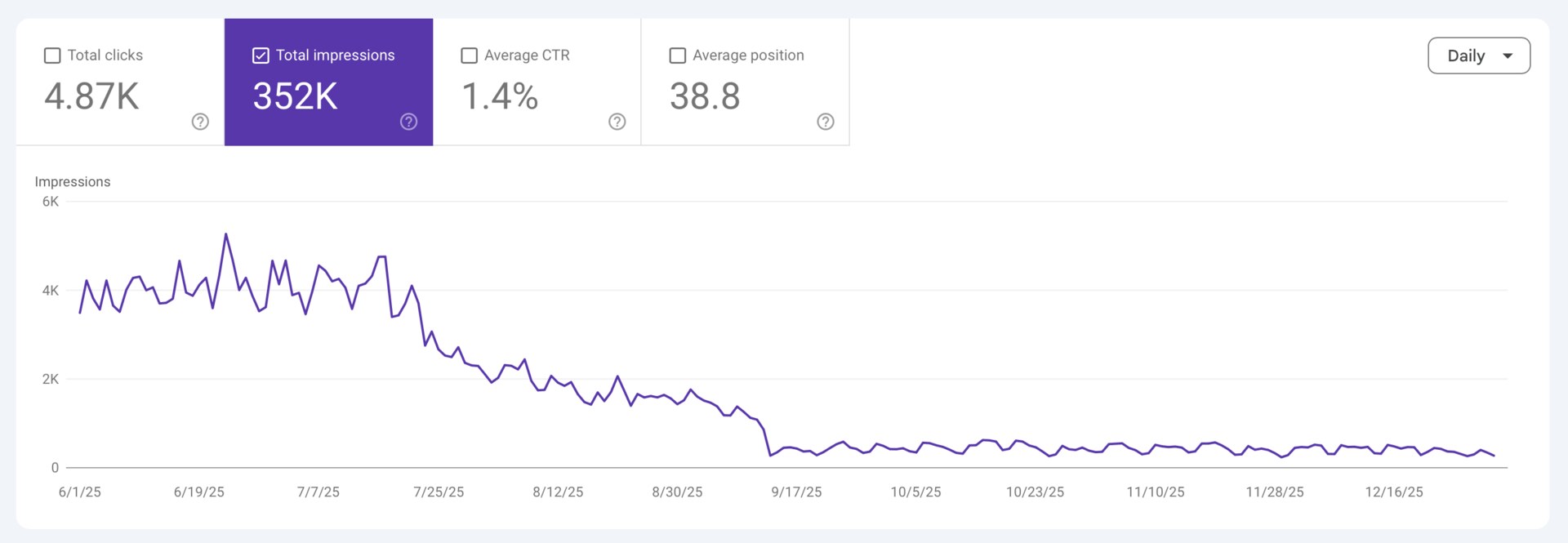
| Organic clicks (before) | StableConsistent organic traffic over several years with gradual growth. Page one rankings for dozens of commercial keywords. |
|---|---|
| Organic clicks (after rebuild) | CollapsedWithin weeks of the new site going live, organic clicks dropped dramatically. The decline was sustained - not a temporary dip, but a structural loss of ranking authority. |
The pattern in Google Search Console was textbook. Impressions held briefly as Google continued to show the old indexed URLs in results, but clicks dropped immediately because those URLs now returned 404 errors or redirected nowhere useful. Within a few weeks, impressions followed as Google re-crawled and de-indexed the broken pages. The new pages, with no search history and no inbound link equity, started from scratch.
Months later, the site still hadn't recovered to anywhere near its previous organic performance. Some of those page one rankings had been built over a decade. Rebuilding that authority from zero takes years, if it's achievable at all.
Why this happens
This isn't an unusual story. It happens regularly, and it almost always follows the same pattern: a business commissions a website rebuild, the focus goes entirely on design and branding, and nobody with SEO experience is in the room when structural decisions are being made.
The technical reality is straightforward. Google ranks URLs, not websites. When you change the URLs, you're not updating your site - from Google's perspective, you're deleting one site and creating a new one. Unless you explicitly tell Google where the old content has moved to (via 301 redirects), it treats every changed URL as a dead page and every new URL as an unknown page with zero authority.
A new page doesn't inherit the ranking position of the old page just because it's on the same domain. That's not how search works. The authority has to be deliberately transferred through redirect mapping, and even then, there's typically a temporary dip while Google re-processes the signals.
What should have happened
-
01Crawl and catalogue every indexed URL
Before touching anything, export a full list of every URL Google has indexed. This is your baseline. Every one of these URLs either needs to stay at the same address or have a 301 redirect to equivalent content on the new site.
-
02Map redirects before the build starts
Redirect mapping isn't something you do on launch day. It should be part of the information architecture phase. If the new URL structure differs from the old one, every old URL needs a mapped destination before any development begins.
-
03Preserve high-ranking page structures
If a page ranks on page one for a competitive keyword, think very carefully before changing its URL, title structure, heading hierarchy, or content focus. These pages are assets. Redesign the visual layer, but preserve the structural elements that Google is ranking.
-
04Stage the rollout
Don't switch every URL at once. Roll out in phases, monitor Search Console after each phase, and catch issues before they compound. A single broken redirect pattern can cascade across hundreds of pages.
-
05Monitor for at least 90 days post-launch
Search Console data lags. The full impact of a migration won't show for weeks. Active monitoring of crawl errors, index coverage, impressions and click-through rates should be standard for at least three months after any structural change.
What the business lost
The new website probably looked great. It may well have ticked every branding box. But the business lost its primary source of inbound leads overnight - and unlike a paid ad campaign you can restart, organic search authority built over a decade can't be switched back on.
The cost isn't just the traffic loss. It's the sales that came from that traffic. It's the compounding effect of years of SEO work evaporating. It's the fact that recovering those rankings - if recovery is even possible - will take years of sustained effort and investment, rebuilding authority that was already there before the rebuild started.
This is why we insist on SEO migration planning as a non-negotiable part of every website rebuild we undertake. It's not an add-on service. It's foundational. If someone tells you it doesn't matter, or that the new site will "rank eventually", they either don't understand how search works or they're not the ones who'll be accountable when the traffic disappears.
The takeaway
If your business depends on organic search for leads, a website rebuild is one of the highest-risk projects you can undertake. Done well, it strengthens your position. Done without an SEO migration plan, it can undo years of work in a single deployment.
The design matters. The branding matters. But if nobody in the room is asking "what happens to our Google rankings when we change these URLs?" - you need someone in the room who will.

Wonder Media is a web design and development agency in Harrogate, building, hosting and looking after websites and web systems since 2006.